
Learning how to add fractions is a fundamental math skill that opens the door to more advanced concepts like algebra, geometry, and real-world problem-solving. Whether you are a student trying to help with homework, a parent refreshing your skills, or an adult looking to sharpen your mind, mastering fractions is essential. Many people find fractions intimidating because they don’t follow the same rules as whole numbers. However, once you understand the core concepts—like denominators, numerators, and common multiples—the process becomes simple and even enjoyable. This guide is designed to take you from feeling confused to feeling confident. We will break down every type of fraction addition, from simple cases with like denominators to complex problems involving mixed numbers and improper fractions. By the end of this article, you will have a clear roadmap for adding any fractions you encounter, ensuring you have a solid foundation for all your future mathematical endeavors.
This guide covers fraction addition for 4th grade, 5th grade and 6th grade students as well as parents and adults refreshing their skills.
For instant answers use our free adding fractions calculator — it shows every step of the working and handles like denominators, unlike denominators and mixed numbers.
Understanding the Anatomy of a Fraction
Before you can learn how to add fractions, you must understand what a fraction actually represents. A fraction is simply a part of a whole. Think of it like a slice of pizza: the whole pizza is the entire unit, and a slice is a fraction of that unit.
The Numerator and Denominator Explained
Every fraction consists of two main parts, and knowing their roles is crucial for successful addition.
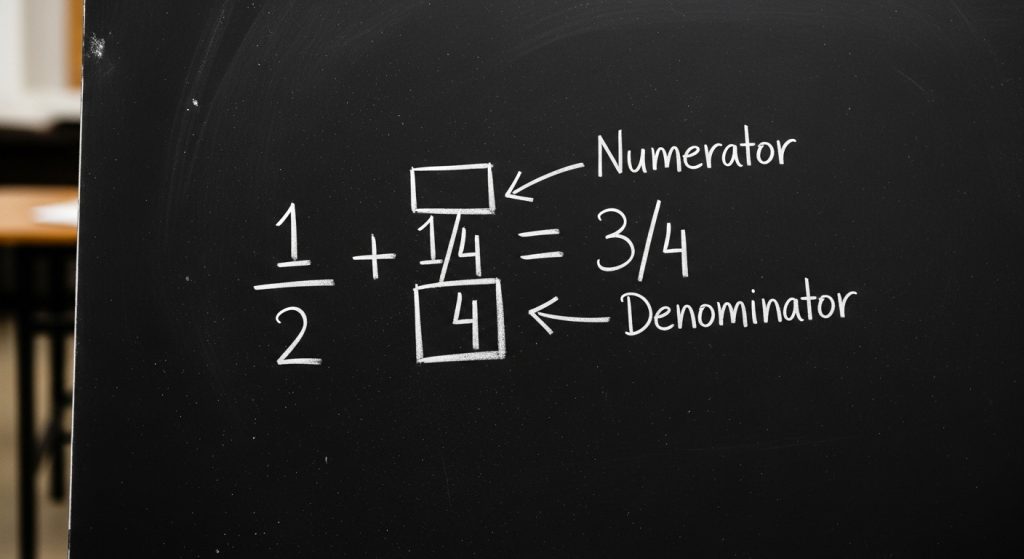
- The Denominator: This is the bottom number of a fraction. It tells you how many equal parts the whole is divided into. For example, in the fraction ( \frac{3}{4} ), the denominator is 4, meaning the whole is cut into 4 equal pieces.
- The Numerator: This is the top number of a fraction. It tells you how many of those equal parts you have. In ( \frac{3}{4} ), the numerator is 3, meaning you have three of the four pieces.
The relationship between these two numbers defines the fraction’s value. When you add fractions, you are essentially combining these parts. The critical rule to remember is that you can only combine parts that are the same size. This means you cannot add fractions unless their denominators are the same. If the denominators are different, the parts are different sizes, and you must make them the same before adding. This concept is the foundation of all fraction addition.
Adding Fractions with Like Denominators — Step by Step

The simplest form of adding fractions occurs when the fractions share the same denominator. This is often the first type of fraction addition students learn, and it serves as the foundation for all more complex operations.
The Golden Rule: Add the Numerators, Keep the Denominator
When you have fractions with like denominators (also known as common denominators), the rule is straightforward. Because the whole is divided into the same number of parts, you can simply add the numerators to see how many total parts you have, while the denominator remains unchanged.
- Formula: ( \frac{a}{c} + \frac{b}{c} = \frac{a+b}{c} )
Example 1:
( \frac{2}{8} + \frac{3}{8} )
The denominator (8) is the same for both. Add the numerators: 2 + 3 = 5.
The answer is ( \frac{5}{8} ). You have five pieces of a whole cut into eight pieces.
Example 2:
( \frac{1}{5} + \frac{2}{5} )
Add the numerators: 1 + 2 = 3. Keep the denominator (5).
The answer is ( \frac{3}{5} ).
This process is intuitive. Imagine a pizza cut into 5 slices. If you have 1 slice and your friend has 2 slices, together you have 3 slices out of 5. The size of the slices (the denominator) never changes; only the quantity (the numerator) changes.
Adding Fractions Rules — Quick Reference
| Situation | Rule | Example |
|---|---|---|
| Same denominators | Add numerators only | 2/5 + 1/5 = 3/5 |
| Different denominators | Find LCD, convert, add | 1/2 + 1/3 = 5/6 |
| Mixed numbers | Whole numbers + fractions separately | 1½ + 2¼ = 3¾ |
| Answer is improper | Convert to mixed number | 7/4 = 1¾ |
| Answer can simplify | Divide by GCF | 2/4 = 1/2 |
Adding Fractions with Unlike Denominators — Step by Step Guide

When you need to add fractions with unlike denominators, such as ( \frac{1}{2} + \frac{1}{3} ), you cannot simply add the numerators. The slices are different sizes. One slice is half a pizza, and the other is a third of a pizza. To combine them, you must convert them into equivalent fractions that share a common denominator.
Why Finding a Common Denominator is Essential
The reason for finding a common denominator is to convert the fractions into a form where they are speaking the same “language.” A common denominator is a number that all original denominators can divide into evenly. This allows you to represent the fractions in smaller, equal-sized units.
The Least Common Denominator (LCD) Method
While you can use any common denominator, the Least Common Denominator (LCD) is the smallest number that both denominators divide into evenly. Using the LCD keeps your numbers smaller and simplifies the process.
- Step 1: Find the LCD. For ( \frac{1}{2} ) and ( \frac{1}{3} ), the multiples of 2 are 2, 4, 6, 8… and multiples of 3 are 3, 6, 9… The smallest common multiple is 6. So, the LCD is 6.
- Step 2: Convert each fraction to an equivalent fraction with the LCD as the denominator. For ( \frac{1}{2} ), multiply the numerator and denominator by 3 to get ( \frac{3}{6} ). For ( \frac{1}{3} ), multiply the numerator and denominator by 2 to get ( \frac{2}{6} ).
- Step 3: Add the new fractions: ( \frac{3}{6} + \frac{2}{6} = \frac{5}{6} ).
How to Add Fractions with Different Denominators — 5 Steps
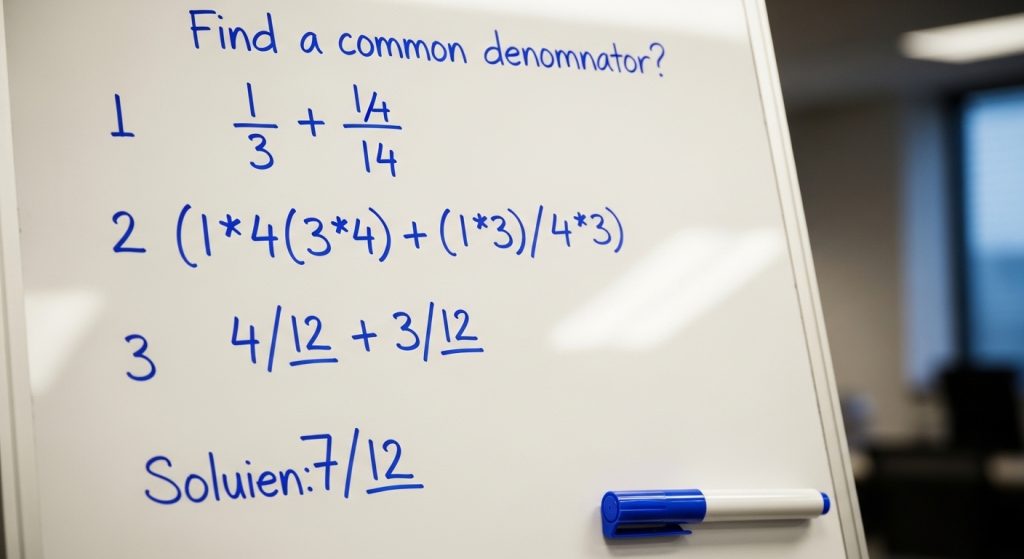
Let’s walk through a detailed, step-by-step process to ensure you never get stuck. This systematic approach works for any fraction addition problem.
Step 1: Identify the Denominators
Look at the fractions you need to add. Write down their denominators. For example, in the problem ( \frac{3}{4} + \frac{2}{5} ), the denominators are 4 and 5.Step 2: Find the Least Common Multiple (LCM)
Find the smallest number that is a multiple of both denominators.
- Multiples of 4: 4, 8, 12, 16, 20, 24…
- Multiples of 5: 5, 10, 15, 20, 25…
The LCM of 4 and 5 is 20. This becomes your LCD.
Step 3: Create Equivalent Fractions
Convert each fraction into an equivalent fraction with the LCD (20) as the new denominator.
- For ( \frac{3}{4} ): Ask yourself, “What do I multiply 4 by to get 20?” The answer is 5. Multiply the numerator (3) by the same number (5). ( 3 \times 5 = 15 ). So, ( \frac{3}{4} = \frac{15}{20} ).
- For ( \frac{2}{5} ): Ask yourself, “What do I multiply 5 by to get 20?” The answer is 4. Multiply the numerator (2) by 4. ( 2 \times 4 = 8 ). So, ( \frac{2}{5} = \frac{8}{20} ).
- Step 4: Add the Numerators
Now that the denominators are the same, add the numerators: ( 15 + 8 = 23 ). Keep the denominator (20).
Step 5: Simplify the Fraction (If Necessary)
The result is ( \frac{23}{20} ). This fraction can be left as an improper fraction or converted to a mixed number. ( \frac{23}{20} ) is the same as ( 1 \frac{3}{20} ).
Simplifying Your Answer: Reducing Fractions to Lowest Terms

Often, after adding fractions, your answer can be simplified. Simplifying, or reducing, a fraction means writing it in its simplest form where the numerator and denominator have no common factors other than 1. This is considered the standard way to present a final answer.
How to Find the Greatest Common Factor (GCF)
To simplify a fraction, you need to find the Greatest Common Factor (GCF) of the numerator and denominator.
- List all the factors of the numerator.
- List all the factors of the denominator.
- Find the largest number that appears in both lists.
Example:
Simplify ( \frac{6}{8} ).
- Factors of 6: 1, 2, 3, 6
- Factors of 8: 1, 2, 4, 8
The GCF is 2.
Divide both the numerator and denominator by the GCF: ( \frac{6 \div 2}{8 \div 2} = \frac{3}{4} ).
So, ( \frac{6}{8} ) simplifies to ( \frac{3}{4} ).
Why Simplifying Matters
While ( \frac{6}{8} ) and ( \frac{3}{4} ) represent the same value, ( \frac{3}{4} ) is considered the “simplest” form. In most math contexts, teachers and professionals expect the final answer to be in lowest terms. It makes the number easier to understand at a glance and is essential for accurate comparisons in real-world applications like cooking, woodworking, or budgeting.
Working with Improper Fractions

An improper fraction is a fraction where the numerator is larger than or equal to the denominator, such as ( \frac{9}{4} ) or ( \frac{5}{3} ). This indicates that the value of the fraction is greater than or equal to 1. After adding fractions, especially those with unlike denominators, you will often end up with an improper fraction.
Converting Improper Fractions to Mixed Numbers
A mixed number combines a whole number and a proper fraction (e.g., ( 2 \frac{1}{4} )). Converting an improper fraction to a mixed number makes the quantity more intuitive.
- Step 1: Divide the numerator by the denominator.
- Step 2: The quotient (the result of the division) becomes the whole number part.
- Step 3: The remainder becomes the numerator of the fractional part.
- Step 4: Keep the denominator the same.
Example:
Convert ( \frac{17}{5} ) to a mixed number.
- 17 ÷ 5 = 3 with a remainder of 2.
- The quotient is 3 (whole number).
- The remainder is 2 (new numerator).
- The denominator stays 5.
The mixed number is ( 3 \frac{2}{5} ).
It’s important to know how to handle both forms. Some equations are easier to solve with improper fractions, while answers are often presented as mixed numbers in everyday life (e.g., “I need 2 and a half cups of sugar”).
Adding Mixed Numbers Step by Step — Two Methods

Mixed numbers, like ( 2 \frac{1}{3} ), combine a whole number with a fraction. Adding them is a common real-world task, such as measuring distances or combining recipe ingredients.
Method 1: Add the Whole Numbers and Fractions Separately
This is often the easiest method for beginners.
- Add the whole numbers together.
- Add the fractions together (ensuring they have a common denominator).
- If the sum of the fractions is an improper fraction, convert it to a mixed number.
- Add the whole number from step 3 to the sum of the whole numbers from step 1.
Example: ( 1 \frac{3}{4} + 2 \frac{2}{4} )
- Whole numbers: 1 + 2 = 3
- Fractions: ( \frac{3}{4} + \frac{2}{4} = \frac{5}{4} = 1 \frac{1}{4} )
- Combine: 3 + ( 1 \frac{1}{4} ) = ( 4 \frac{1}{4} )
Method 2: Convert to Improper Fractions
This method is systematic and reduces the risk of forgetting to handle a whole number.
- Convert each mixed number into an improper fraction.
- Add the improper fractions (find a common denominator if needed).
- Convert the result back to a mixed number if desired.
Example: ( 1 \frac{3}{4} + 2 \frac{2}{4} )
- Convert: ( 1 \frac{3}{4} = \frac{7}{4} ); ( 2 \frac{2}{4} = \frac{10}{4} )
- Add: ( \frac{7}{4} + \frac{10}{4} = \frac{17}{4} )
- Convert: ( \frac{17}{4} = 4 \frac{1}{4} )
Both methods are correct. Choose the one that feels most comfortable and logical to you.
Common Mistakes When Adding Fractions (And How to Avoid Them)

Even with a solid understanding, small errors can creep in. Being aware of the most common pitfalls can save you time and frustration.
Mistake 1: Adding Denominators
This is the most frequent error. Many new learners want to add the numerators and the denominators. Remember: The denominator represents the size of the pieces and does not change when you add.
- Wrong: ( \frac{1}{4} + \frac{1}{4} = \frac{2}{8} )
- Right: ( \frac{1}{4} + \frac{1}{4} = \frac{2}{4} = \frac{1}{2} )
Mistake 2: Forgetting to Convert Both Fractions
When finding a common denominator, you must convert both fractions. A common error is to convert only one fraction.
- Wrong: ( \frac{1}{2} + \frac{1}{4} = \frac{2}{4} + \frac{1}{4} ) (Incorrect, because ( \frac{1}{2} ) was converted to ( \frac{2}{4} ), but the other fraction was left unchanged, which is fine, but forgetting to multiply the numerator for ( \frac{1}{4} ) would be the mistake. The correct conversion is ( \frac{2}{4} + \frac{1}{4} ) is actually correct here, but the mistake is when you only convert one and not the other for the second fraction. A better example: ( \frac{1}{3} + \frac{1}{6} ). The error would be converting only ( \frac{1}{3} ) to ( \frac{2}{6} ) and leaving ( \frac{1}{6} ) as is, which is actually correct if you convert properly. Let’s illustrate a clearer error: For ( \frac{1}{3} + \frac{1}{2} ), a learner might find the LCD of 6, then convert ( \frac{1}{3} ) to ( \frac{2}{6} ) and incorrectly convert ( \frac{1}{2} ) to ( \frac{1}{6} ) by only changing the denominator.)
- Right: Always multiply both the numerator and denominator of each fraction by the necessary factor to achieve the common denominator.
Mistake 3: Not Simplifying the Final Answer
Leaving an answer as ( \frac{2}{4} ) or ( \frac{4}{6} ) is technically correct but incomplete. Always check if the fraction can be reduced to its simplest form. This is a key part of presenting a polished answer.
Real-World Applications: Where You Use Fraction Addition

Understanding how to add fractions isn’t just about passing a test; it’s a practical life skill. Recognizing where you use these skills can make the learning process more meaningful.
In the Kitchen: Cooking and Baking
Recipes are full of fractions. If a recipe calls for ( \frac{3}{4} ) cup of flour and you want to double the recipe, you need to add ( \frac{3}{4} + \frac{3}{4} ). Similarly, if you need ( \frac{1}{2} ) cup of sugar for one recipe and ( \frac{1}{3} ) cup for another, you must add fractions to know how much to buy.
In Home Improvement: Measuring and Cutting
Whether you are hanging a picture, building a bookshelf, or sewing a curtain, you will work with measurements. If a board needs to be ( 2 \frac{1}{4} ) feet long and you need to attach another piece that is ( 1 \frac{3}{8} ) feet long, adding fractions tells you the total length.
In Time Management
Frequently, we think of time in fractions of an hour. If a meeting lasts ( \frac{1}{2} ) hour and a follow-up task takes ( \frac{3}{4} ) hour, knowing how to add these fractions helps you schedule your day accurately.
Visualizing Fractions with Models and Drawings

For visual learners, abstract numbers can be challenging. Using visual models can solidify the concept of common denominators and fraction addition in a powerful way.
Using Fraction Bars or Circles
Fraction bars (or circles) are rectangular or circular models divided into equal parts.
- To add ( \frac{1}{2} + \frac{1}{4} ), draw a rectangle and divide it into 4 equal parts (quarters).
- Shade ( \frac{1}{2} ) of the rectangle. Since half of 4 is 2, you would shade 2 of the 4 parts.
- Now, shade ( \frac{1}{4} ) in a different color (1 part).
- Count the total shaded parts: 3 out of 4, or ( \frac{3}{4} ).
This visual representation makes it clear why ( \frac{1}{2} ) becomes ( \frac{2}{4} ) and why the answer is ( \frac{3}{4} ).
The Number Line Method
A number line is another excellent tool. Mark the line from 0 to 1 and divide it into equal segments based on your denominators.
- To add ( \frac{1}{3} + \frac{1}{6} ), you can use a number line marked in sixths. Start at ( \frac{1}{3} ), which is the same as ( \frac{2}{6} ).
- From that point, move forward ( \frac{1}{6} ). You will land on ( \frac{3}{6} ), which simplifies to ( \frac{1}{2} ).
Using Technology and Tools to Check Your Work

In the digital age, you have powerful tools at your disposal to verify your fraction addition. While it’s crucial to understand the concepts, using these tools for checking your work can boost confidence and catch errors.
Online Fraction Calculators
Many reputable websites offer free fraction calculators. These tools allow you to input fractions and see the step-by-step solution. They are excellent for checking homework or for understanding the intermediate steps of a problem you might be stuck on. However, use them as a learning aid, not a crutch. Try to solve the problem yourself first, then use the calculator to verify your answer.
Using Your Smartphone
Most modern smartphones have calculator apps that can handle fractions, often by using the “÷” symbol for a fraction bar. More advanced calculator apps or standard scientific calculators have a specific “a b/c” button that allows you to input mixed numbers and fractions directly. This is a fast way to confirm your final sum.
Teaching Fractions to Others

Once you master how to add fractions, you may find yourself in a position to teach a child, a sibling, or a friend. Teaching is one of the best ways to solidify your own understanding.
Start with Concrete Examples
Use tangible objects like slices of bread, chocolate bars, or LEGO bricks. Show that you cannot combine a half piece of bread with a quarter piece without breaking the half into two quarters. This hands-on approach makes the abstract concept of “common denominator” feel physical and real.
Emphasize the “Why” Behind the Rule
Don’t just tell them to “find the common denominator.” Explain why they need to do it. Use the pizza analogy: “You can’t add a half-slice to a third-slice directly because they are different sizes. You have to cut them into the same size pieces first.” This builds conceptual understanding rather than just rote memorization.
Adding 3 Fractions — How to Add Three Fractions

The principles you’ve learned apply even when you have more than two fractions to add. The process remains the same: find a common denominator that works for all fractions, convert them, and then sum the numerators.
Finding the LCD for Multiple Fractions
When dealing with three or more fractions, like ( \frac{1}{2} + \frac{1}{3} + \frac{1}{4} ), you need to find a number that is a multiple of all denominators (2, 3, and 4).
- List multiples of the largest denominator. The largest is 4: 4, 8, 12, 16…
- Is 4 a multiple of 2 and 3? No.
- Is 8 a multiple of 2 and 3? No.
- Is 12 a multiple of 2, 3, and 4? Yes (2×6, 3×4, 4×3).
The LCD is 12.
The Step-by-Step Approach
- Convert each fraction: ( \frac{1}{2} = \frac{6}{12} ), ( \frac{1}{3} = \frac{4}{12} ), ( \frac{1}{4} = \frac{3}{12} )
- Add the new numerators: 6 + 4 + 3 = 13
- Keep the denominator: ( \frac{13}{12} )
- Simplify to a mixed number: ( 1 \frac{1}{12} )
This method scales easily. No matter how many fractions you have, the process is systematic and reliable.
How to Add Fractions with Whole Numbers

Combining a whole number with a fraction is one of the simplest operations. It often comes up in real life when you have a certain number of whole items and an additional part of an item.
The Simple Combination Method
When adding a whole number and a fraction, you don’t need to perform any complex conversions. You simply combine them to form a mixed number.
- Example: 5 + ( \frac{2}{3} ) = ( 5 \frac{2}{3} )
When the Whole Number is Part of a Mixed Number
If you are adding a mixed number and a whole number, add the whole numbers first and then attach the fraction.
- Example: ( 3 \frac{1}{4} ) + 2
- Add the whole numbers: 3 + 2 = 5
- Attach the fraction: ( 5 \frac{1}{4} )
This works because the whole numbers represent complete units, while the fraction represents a part. They don’t interfere with each other’s denominators.
The Connection Between Fractions and Decimals

Fractions and decimals are two different ways of representing the same concept: parts of a whole. Understanding the connection can provide an alternative strategy for adding fractions, especially if you are more comfortable with decimals.
Converting Fractions to Decimals for Addition
Every fraction can be converted to a decimal by dividing the numerator by the denominator.
- ( \frac{1}{2} = 0.5 )
- ( \frac{3}{4} = 0.75 )
- ( \frac{2}{5} = 0.4 )
If you have a problem like ( \frac{1}{2} + \frac{3}{4} ), you could convert it to decimals: 0.5 + 0.75 = 1.25. Then, if needed, convert the decimal back to a fraction (1.25 = ( 1 \frac{1}{4} )).
When This Method is Useful
This approach can be helpful for quick mental math or when you have a calculator. However, be aware that some fractions, like ( \frac{1}{3} ), convert to repeating decimals (0.333…), which can make accurate addition tricky without rounding. For this reason, mastering the fraction method (using common denominators) is essential for precision.
Frequently Asked Questions About Adding Fractions
Over time, certain questions about fraction addition arise repeatedly. Let’s address some of the most common ones to clear up any lingering confusion.
What is the difference between a common denominator and a least common denominator?
A common denominator is any number that all denominators can divide into evenly. For ( \frac{1}{2} ) and ( \frac{1}{4} ), common denominators include 4, 8, 12, 16, etc. The Least Common Denominator is the smallest of these numbers (4). Using the LCD is preferred because it keeps the numbers smaller and reduces the need for simplifying later.
Can I add fractions without a common denominator?
Technically, no. Adding fractions without a common denominator is like trying to add apples and oranges. You must convert them to equivalent fractions with a common denominator before you can combine the numerators. Any attempt to add them directly will result in an incorrect answer.
What do I do if the sum of the numerators is larger than the denominator?
If the sum of the numerators is larger than the denominator, you have an improper fraction. This is perfectly fine. You should then convert it to a mixed number for a final answer that is easy to interpret. For example, ( \frac{7}{4} ) becomes ( 1 \frac{3}{4} ).
A Practical Workflow for Solving Any Fraction Addition Problem

To consolidate everything we’ve covered, here is a universal workflow you can apply to any fraction addition problem. This systematic approach ensures you won’t miss a step.
The 5-Step Universal Workflow
- Check Denominators: Are they the same?
- If YES, proceed to step 4.
- If NO, proceed to step 2.
- Find the Common Denominator: Determine the LCD of all fractions in the problem.
- Create Equivalent Fractions: Rewrite each fraction with the LCD.
- Add the Numerators: Sum the numerators. Keep the denominator unchanged.
- Simplify: Convert any improper fractions to mixed numbers and reduce the fraction to its lowest terms.
Apply the Workflow to a Complex Example
Problem: ( 1 \frac{2}{3} + \frac{5}{6} )
- Denominators: 3 and 6 are different.
- LCD: The LCD of 3 and 6 is 6.
- Convert: ( 1 \frac{2}{3} = \frac{5}{3} = \frac{10}{6} ). The second fraction is ( \frac{5}{6} ).
- Add: ( \frac{10}{6} + \frac{5}{6} = \frac{15}{6} )
- Simplify: ( \frac{15}{6} = \frac{5}{2} = 2 \frac{1}{2} )
By following this workflow, you can solve any problem with confidence and accuracy.
Building a Strong Foundation for Future Math

Mastering how to add fractions is more than just a standalone skill. It is a critical building block for higher-level mathematics. A strong understanding of fractions is non-negotiable for success in algebra, calculus, and even fields like computer science and engineering.
Fractions and Algebra
In algebra, you work with variables (like x and y). Adding fractions with variables uses the exact same principles. For example, to solve ( \frac{x}{2} + \frac{x}{3} ), you find the common denominator (6) and rewrite as ( \frac{3x}{6} + \frac{2x}{6} = \frac{5x}{6} ). Without the foundational fraction skills, algebra becomes exponentially more difficult.
Fractions in Everyday Life
Beyond academics, fractions are woven into the fabric of daily life. From financial literacy (understanding percentages, which are fractions of 100) to DIY projects and nutrition, fraction fluency equips you with the precision needed to navigate the world effectively. By investing time in learning this now, you are building a skill that will serve you for a lifetime.
Overcoming Math Anxiety Around Fractions

Many people experience anxiety when faced with fractions. This is often due to past negative experiences or a belief that they are “not a math person.” It is crucial to understand that this anxiety can be overcome with the right mindset and approach.
Shift Your Mindset
Instead of thinking, “I’m bad at fractions,” tell yourself, “I am learning a new skill.” Everyone learns at their own pace. Fractions are a system of rules, and like learning a new language or a musical instrument, it requires practice and patience. Celebrate small victories, like solving a problem correctly on your own.
Practice with Low-Stakes Problems
Start with simple problems that you know you can solve. Use visual aids, like the fraction bars mentioned earlier. Gradually increase the difficulty as your confidence grows. There are countless online resources and apps that turn fraction practice into a game, which can make the learning process less intimidating and more engaging. Remember, every expert was once a beginner.
Adding Fractions Practice Problems
Try these problems yourself — answers below:
- 1/4 + 2/4 = ?
- 1/3 + 1/6 = ?
- 2/5 + 1/3 = ?
- 1½ + 2¼ = ?
- 3 + 1/4 = ?
Answers: 1) 3/4 2) 1/2 3) 11/15
4) 3¾ 5) 3¼
For more practice check our
[free fraction worksheets]
Related Fraction Tools and Guides
- Adding Fractions Calculator — instant
answers with step-by-step working - Subtracting Fractions — complete guide
- How to Add Fractions for Kids — simple
version for younger learners - [Free Fraction Worksheets] — coming soon
- [Multiplying Fractions] — coming soon
Conclusion: Your Journey to Fraction Mastery

You’ve now taken a comprehensive journey through the world of fraction addition. From understanding the basic anatomy of a numerator and denominator to tackling complex mixed numbers and improper fractions, you have the tools you need to succeed. Remember, the key is to always ensure your denominators match, and then simply add the numerators. Whether you are visualizing with pizza slices, using the 5-step workflow, or applying this knowledge to a real-world project like cooking or building, the principles remain the same.
To continue building your skills and explore more advanced topics, we encourage you to explore the resources available at howtoaddfractions.com . Our site offers additional guides, practice problems, and tools to help you reinforce what you’ve learned and take your math skills to the next level. Don’t be afraid to make mistakes—each one is a stepping stone to understanding. With consistent practice and a positive mindset, adding fractions will become second nature.
Pinterest-Friendly Conclusion: Pin this guide to your “Study Tips” or “Math Help” board for a quick and reliable reference! Bookmark it to revisit whenever you need a refresher. Learning how to add fractions doesn’t have to be hard—it just takes the right steps and a little practice. Share this with a friend who needs a math confidence boost!
Common Fraction Addition Problems — Quick Answers
Q1: What is 1/2 + 1/3?
Answer: 5/6. LCD of 2 and 3 is 6.
Convert 1/2 to 3/6 and 1/3 to 2/6.
Add: 3/6 + 2/6 = 5/6.
Q2: What is 1/4 + 1/4?
Answer: 1/2. Same denominators — add
numerators: 1+1=2. Result: 2/4 = 1/2.
Q3: What is 3/4 + 1/2?
Answer: 5/4 or 1¼. LCD is 4.
Convert 1/2 to 2/4.
Add: 3/4 + 2/4 = 5/4,
Q4: What is 1/2 + 1/4?
Answer: 3/4. LCD is 4.
Convert 1/2 to 2/4.
Add: 2/4 + 1/4 = 3/4
Q5: What is 2/3 + 1/6?
‘Answer: 5/6. LCD is 6.
Convert 2/3 to 4/6.
Add: 4/6 + 1/6 = 5/6.
Q6: What is 1/3 + 1/4?
Answer: 7/12. LCD is 12.
Convert 1/3 to 4/12 and 1/4 to 3/12.
Add: 7/12.
Q7: What is 1/2 + 1/2?
Answer: 1. Same denominators — add
numerators: 1+1=2.
Result: 2/2 = 1.
Q8: What is 3/8 + 1/8?
Answer: 1/2. Same denominators.
3+1=4. Result: 4/8 = 1/2.
Frequently Asked Questions (FAQ)
Q1: What is the first step in adding fractions?
The first step is to look at the denominators. If they are the same, you can add the numerators directly. If they are different, you must find a common denominator and create equivalent fractions before adding.
Q2: Why do we need to find a common denominator?
We find a common denominator to ensure the parts we are adding are the same size. It is impossible to accurately combine fractions that represent different-sized pieces of a whole without converting them to a common unit.
Q3: Can I add fractions with different denominators without finding the LCM?
Yes, you can find any common denominator by multiplying the denominators together. However, this often results in large numbers that require more simplification at the end. Using the Least Common Multiple (LCM) keeps the process simpler.
Q4: What is an improper fraction, and how do I handle it in addition?
An improper fraction has a numerator larger than or equal to its denominator. When you get an improper fraction as a result of addition, you should usually convert it to a mixed number (e.g., ( \frac{7}{4} ) becomes ( 1 \frac{3}{4} )) for a final, easily understandable answer.
Q5: Is it necessary to simplify fractions in my answer?
Yes, simplifying fractions to their lowest terms is considered standard practice in math. It shows that you have completed the problem fully and makes the answer easier to read and compare.