
Subtracting Fractions Calculator
Try an example:
The Fastest Way to Learn Subtracting Fractions — With Every Step Shown
Subtracting fractions follows the same core principle as adding them — the denominators must match before you can subtract the numerators. Once you understand that one rule everything else follows logically. This guide teaches you how to subtract fractions step by step — from the simplest like-denominator problems through mixed numbers and whole number combinations.
Use the subtracting fractions calculator above for instant answers with full working shown. Read the guide below to understand exactly what the calculator is doing — so you can solve any problem confidently on your own.
This page covers every type of fraction subtraction problem you will encounter — subtracting fractions with like denominators, subtracting fractions with unlike denominators, subtracting mixed numbers and subtracting fractions with whole numbers. Every section includes worked examples, common mistakes and practice problems.
How to Subtract Fractions — The Core Rule
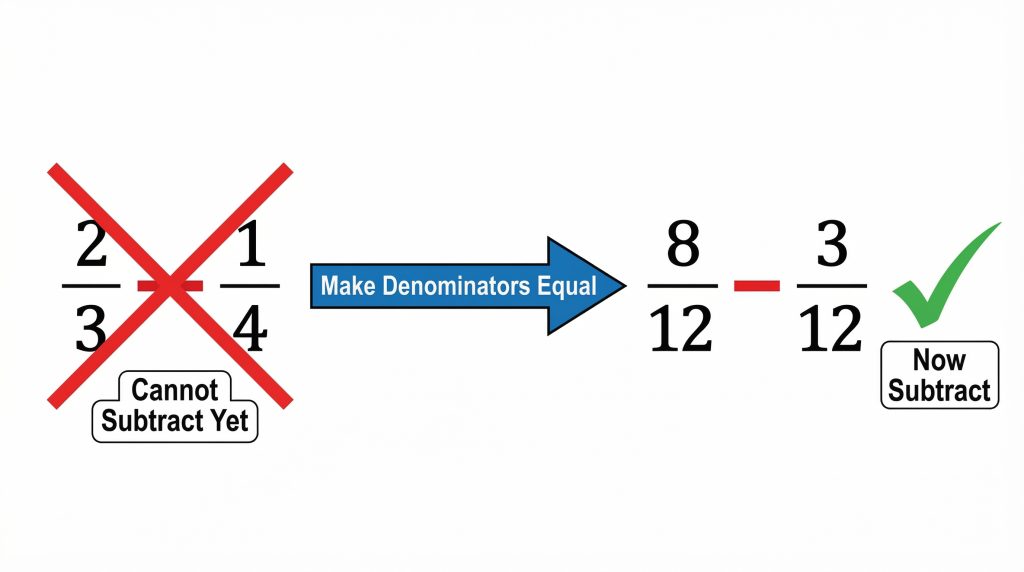
Before learning specific methods it is essential to understand why fraction subtraction requires matching denominators.
A denominator tells you how many equal pieces the whole has been divided into. If one fraction has a denominator of 4 (four equal pieces) and another has a denominator of 3 (three equal pieces) the pieces are different sizes — you cannot subtract them directly any more than you can subtract centimeters from inches without converting first.
The core rule of subtracting fractions is this:
Make the denominators equal first. Then subtract the numerators. Keep the denominator.
This rule applies to every type of fraction subtraction — whether the denominators are already equal or whether you need to find the LCD to make them equal.
Subtracting Fractions with Like Denominators — The Easy Case
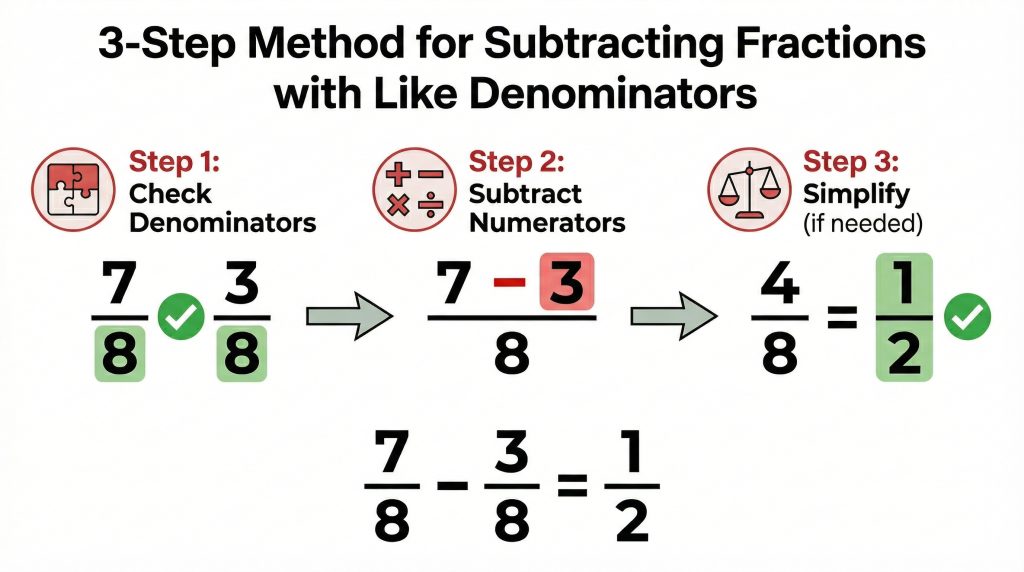
Subtracting fractions with like denominators is the simplest case. When both fractions share the same bottom number the whole is already divided into the same sized pieces — you can subtract the numerators directly.
The 3-Step Method for Like Denominators
Step 1: Confirm both denominators are the same Step 2: Subtract the top numbers (numerators) Step 3: Keep the denominator unchanged — then simplify if possible
Example 1:
7/8 − 3/8 Denominators are both 8 ✓ Subtract numerators: 7 − 3 = 4 Keep denominator: 8 Result: 4/8 Simplify: GCF of 4 and 8 is 4 → Answer: 1/2
Example 2:
5/9 − 2/9 Denominators are both 9 ✓ Subtract numerators: 5 − 2 = 3 Keep denominator: 9 Result: 3/9 Simplify: GCF of 3 and 9 is 3 → Answer: 1/3
Example 3:
11/12 − 5/12 Denominators are both 12 ✓ Subtract numerators: 11 − 5 = 6 Keep denominator: 12 Result: 6/12 Simplify: GCF of 6 and 12 is 6 → Answer: 1/2
💡 PRO TIP: Always check if your answer can be simplified. Leaving 6/12 or 4/8 unsimplified is technically correct but considered incomplete in most classroom and exam settings. Find the GCF of the numerator and denominator and divide both by it.
Subtracting Fractions with Unlike Denominators
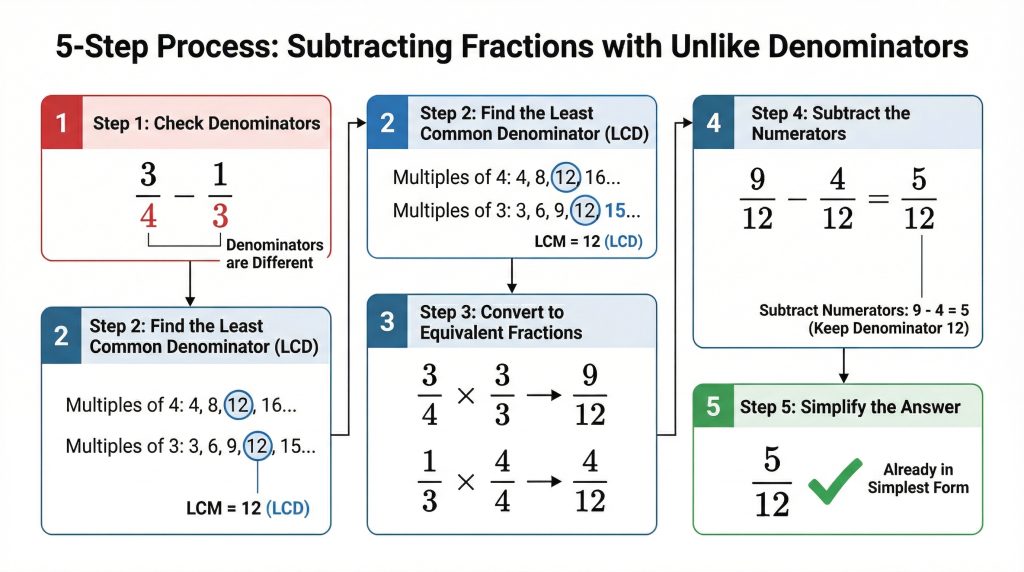
Subtracting fractions with unlike denominators requires one extra stage before you can subtract — converting both fractions to equivalent fractions that share the same denominator.
How to Subtract Fractions with Different Denominators — 5 Steps
Step 1: Identify that the denominators are different Step 2: Find the Least Common Denominator (LCD) — the smallest number both denominators divide into evenly Step 3: Convert each fraction to an equivalent fraction with the LCD as the new denominator Step 4: Subtract the numerators — keep the LCD as the denominator Step 5: Simplify the result if possible
Example 1: 3/4 − 1/3
Step 1: Denominators are 4 and 3 — different ✗ Step 2: Find LCD
- Multiples of 4: 4, 8, 12, 16…
- Multiples of 3: 3, 6, 9, 12, 15…
- LCD = 12 Step 3: Convert both fractions
- 3/4 → multiply by 3/3 → 9/12
- 1/3 → multiply by 4/4 → 4/12 Step 4: Subtract numerators: 9 − 4 = 5. Keep denominator: 12 Step 5: Simplify: 5 and 12 share no common factors Answer: 5/12
Example 2: 5/6 − 1/4
Step 1: Denominators are 6 and 4 — different ✗ Step 2: Find LCD
- Multiples of 6: 6, 12, 18…
- Multiples of 4: 4, 8, 12, 16…
- LCD = 12 Step 3: Convert both fractions
- 5/6 → multiply by 2/2 → 10/12
- 1/4 → multiply by 3/3 → 3/12 Step 4: Subtract numerators: 10 − 3 = 7. Keep denominator: 12 Step 5: Simplify: 7 and 12 share no common factors Answer: 7/12
Example 3: 2/3 − 1/6
Step 1: Denominators are 3 and 6 — different ✗ Step 2: Find LCD
- 6 is already a multiple of 3
- LCD = 6 Step 3: Convert 2/3 → multiply by 2/2 → 4/6
- 1/6 already has denominator 6 — no conversion needed Step 4: Subtract numerators: 4 − 1 = 3. Keep denominator: 6 Step 5: Simplify: GCF of 3 and 6 is 3 → 3/6 = 1/2 Answer: 1/2
Subtracting Fractions with Different Denominators — Cross Multiplication Method
An alternative to the LCD method is cross multiplication. This works for any two fractions and avoids the step of finding the LCD — though it often produces larger numbers that need more simplification.
Formula: a/b − c/d = (ad − bc) / bd
Example: 3/4 − 1/3
= (3×3 − 1×4) / (4×3) = (9 − 4) / 12 = 5/12
Both methods produce the same answer. The LCD method is preferred when the denominators are large because it keeps numbers smaller throughout.
How to Subtract Mixed Numbers
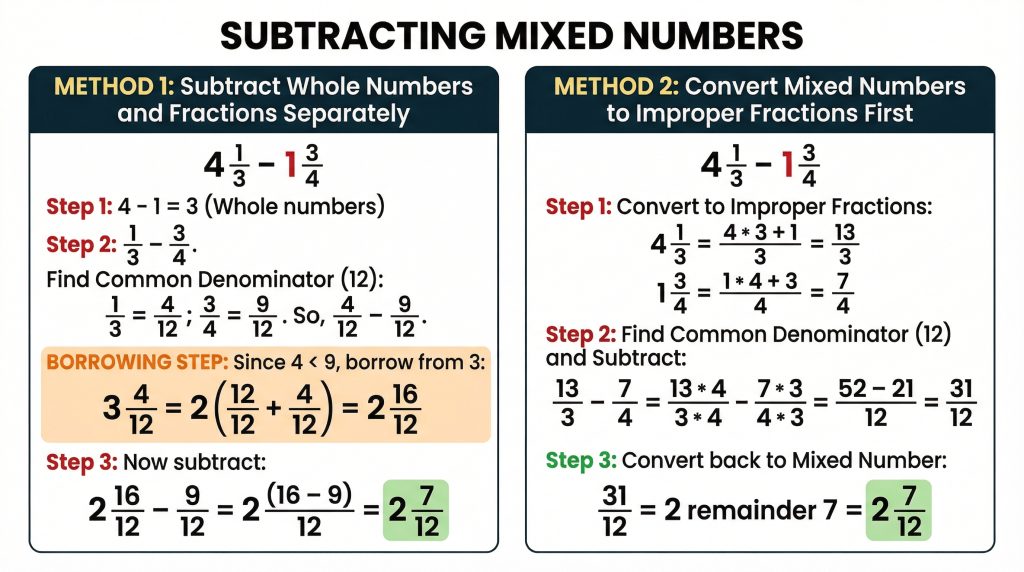
Subtracting mixed numbers — numbers like 3½ or 4¾ — can be done using two reliable methods. Choose whichever feels more natural.
Method 1 — Subtract Whole Numbers and Fractions Separately
- Subtract the whole number parts
- Subtract the fraction parts (find LCD if needed)
- If the second fraction is larger than the first — borrow 1 from the whole number
- Combine the results
Example: 4⅓ − 1¾
Fractions: 1/3 − 3/4 1/3 is smaller than 3/4 — need to borrow Borrow 1 from 4 → whole number becomes 3 Add borrowed 1 to 1/3 → 1 + 1/3 = 4/3 Now subtract: 4/3 − 3/4 LCD of 3 and 4 = 12 4/3 = 16/12 and 3/4 = 9/12 16/12 − 9/12 = 7/12 Whole numbers: 3 − 1 = 2 Answer: 2 and 7/12
Method 2 — Convert to Improper Fractions First
This method is more systematic and reduces the risk of borrowing errors.
- Convert each mixed number to an improper fraction
- Find the LCD and subtract
- Convert the result back to a mixed number
Example: 4⅓ − 1¾
Convert: 4⅓ = (4×3+1)/3 = 13/3 Convert: 1¾ = (1×4+3)/4 = 7/4 Find LCD: LCD of 3 and 4 = 12 13/3 = 52/12 and 7/4 = 21/12 Subtract: 52/12 − 21/12 = 31/12 Convert back: 31 ÷ 12 = 2 remainder 7 Answer: 2 and 7/12 ✓
Both methods give the same answer. Method 2 is recommended for beginners because it removes the borrowing step entirely.
Subtracting Mixed Fractions — Common Mistake to Avoid
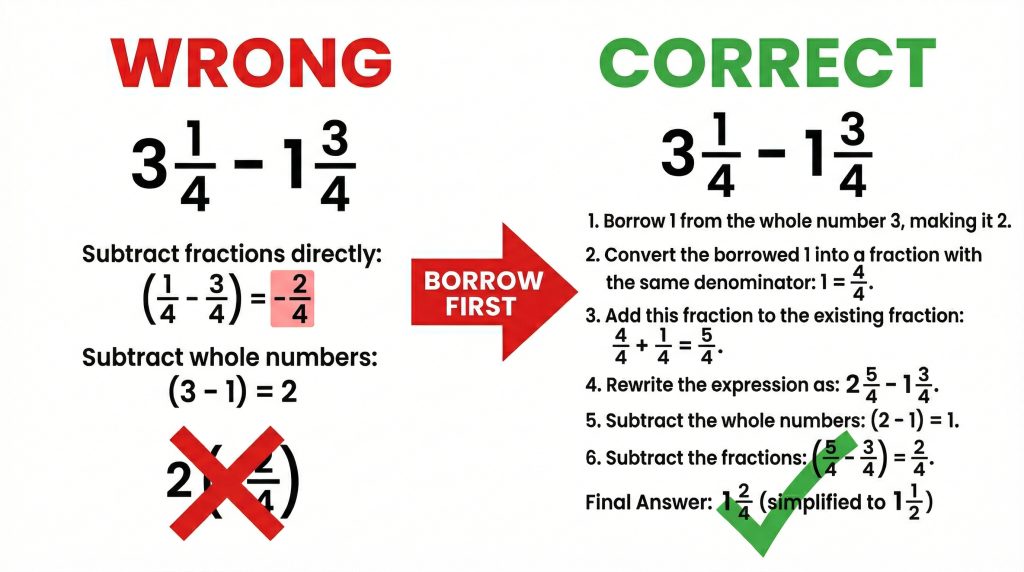
The most common error when subtracting mixed fractions is forgetting to borrow when the fraction in the second number is larger than the fraction in the first. If you skip this step you will get a negative fraction part — which signals that borrowing was needed.
Wrong: 3⅓ − 1¾ = 2 and (1/3 − 3/4) = 2 and (−5/12) ← INCORRECT Right: Borrow from whole number first → 2 and (4/3 − 3/4) = 2 and 7/12 ✓
Subtracting Fractions with Whole Numbers
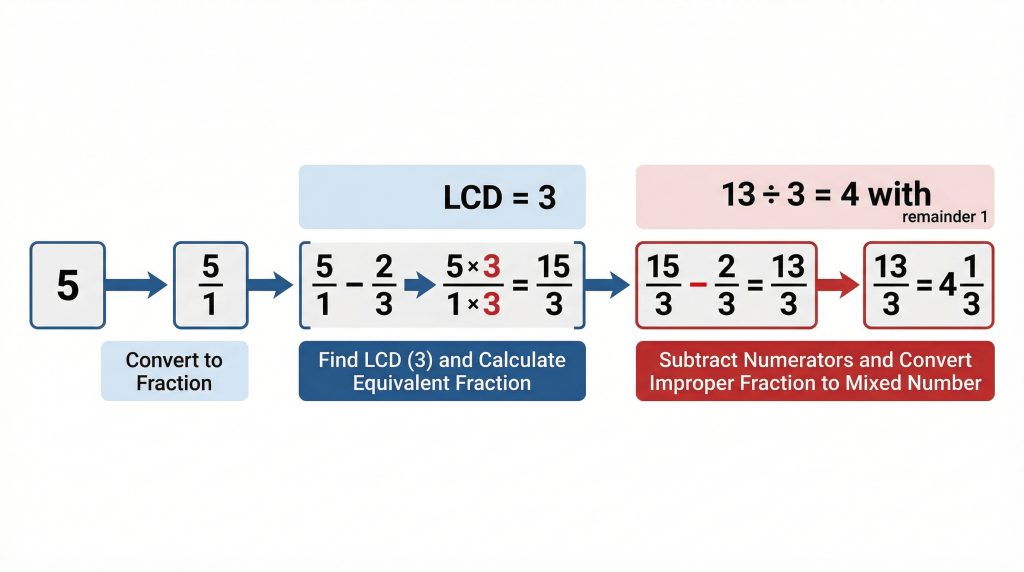
Subtracting fractions with whole numbers is straightforward once you know the conversion trick — write the whole number as a fraction by placing it over 1.
Subtracting a Fraction FROM a Whole Number
Example: 5 − 2/3
Write 5 as a fraction: 5 = 5/1 Find LCD of 1 and 3 = 3 Convert: 5/1 → 15/3 Subtract: 15/3 − 2/3 = 13/3 Convert to mixed number: 4⅓
Example: 3 − 3/4
Write 3 as 3/1 LCD of 1 and 4 = 4 Convert: 3/1 → 12/4 Subtract: 12/4 − 3/4 = 9/4 Convert: 2¼
Subtracting a Whole Number FROM a Mixed Number
Example: 3½ − 2
No fraction conversion needed Subtract whole numbers: 3 − 2 = 1 Keep fraction: ½ Answer: 1½
Subtracting Improper Fractions
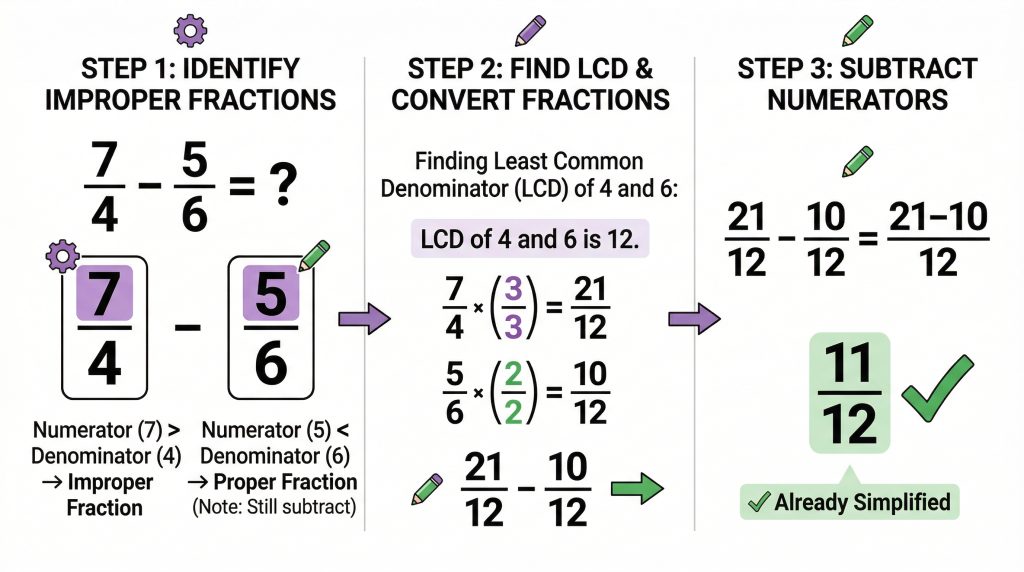
Subtracting improper fractions — fractions where the numerator is larger than the denominator — follows exactly the same process as subtracting proper fractions.
Example: 7/4 − 5/6
LCD of 4 and 6 = 12 Convert: 7/4 → 21/12 Convert: 5/6 → 10/12 Subtract: 21/12 − 10/12 = 11/12 Simplify: 11 and 12 share no common factors Answer: 11/12
Example: 9/4 − 3/4
Same denominators — subtract directly 9 − 3 = 6 → 6/4 Simplify: GCF of 6 and 4 is 2 → 3/2 or 1½
Use the Subtract Fractions Calculator
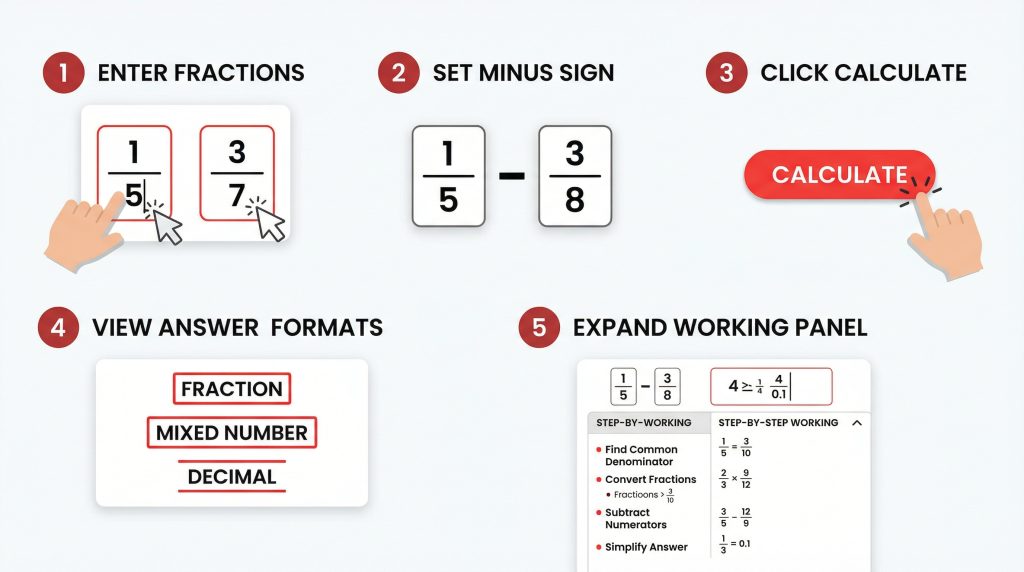
Our free subtract fractions calculator solves any fraction subtraction problem instantly and shows every step of the working. It handles all types of fraction subtraction — like denominators, unlike denominators and mixed numbers.
How to use the subtracting fractions calculator:
- Enter the numerator and denominator of your first fraction
- Enter the numerator and denominator of your second fraction
- Press Calculate
- Read your answer as a fraction, mixed number and decimal
- Read the full step-by-step working below the answer
The calculator uses the same LCD method shown in the examples above — so comparing the calculator’s working to the manual method is an excellent learning exercise.
Common Fraction Subtraction Problems — Answered
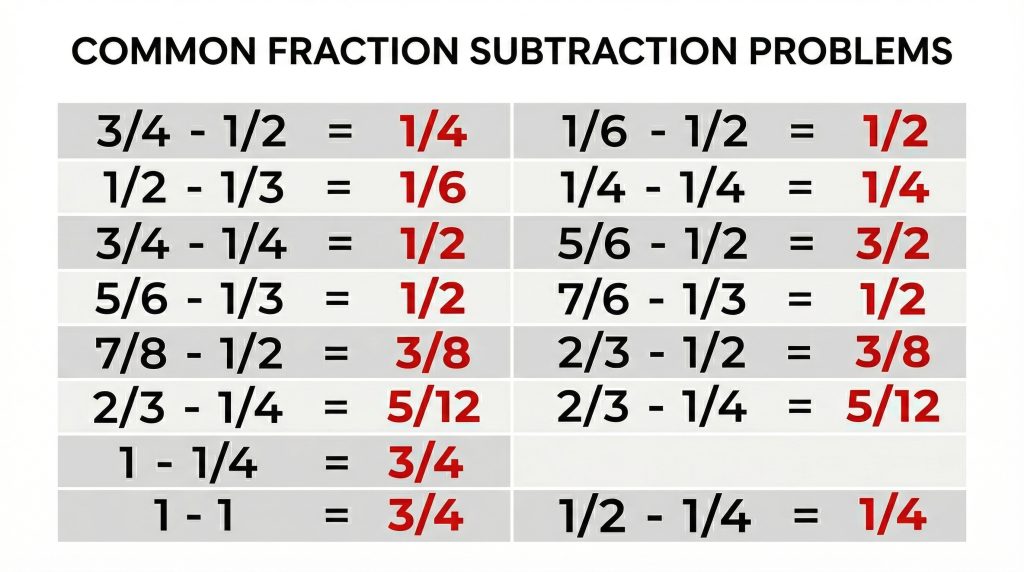
These are the most searched fraction subtraction problems. Each one can be verified using the calculator above.
What is 3/4 − 1/2?
Answer: 1/4 LCD of 4 and 2 is 4. Convert 1/2 to 2/4. Subtract: 3/4 − 2/4 = 1/4. Decimal: 0.25.
What is 1/2 − 1/3?
Answer: 1/6 LCD of 2 and 3 is 6. Convert 1/2 to 3/6 and 1/3 to 2/6. Subtract: 3/6 − 2/6 = 1/6. Decimal: 0.167.
What is 3/4 − 1/4?
Answer: 1/2 Same denominators. Subtract numerators: 3 − 1 = 2. Result: 2/4. Simplify: GCF is 2. Answer: 1/2. Decimal: 0.5.
What is 5/6 − 1/3?
Answer: 1/2 LCD of 6 and 3 is 6. Convert 1/3 to 2/6. Subtract: 5/6 − 2/6 = 3/6 = 1/2. Decimal: 0.5.
What is 7/8 − 1/2?
Answer: 3/8 LCD of 8 and 2 is 8. Convert 1/2 to 4/8. Subtract: 7/8 − 4/8 = 3/8. Decimal: 0.375.
What is 2/3 − 1/4?
Answer: 5/12 LCD of 3 and 4 is 12. Convert 2/3 to 8/12 and 1/4 to 3/12. Subtract: 8/12 − 3/12 = 5/12. Decimal: 0.417.
What is 1 − 1/4?
Answer: 3/4 Write 1 as 4/4. Subtract: 4/4 − 1/4 = 3/4. Decimal: 0.75.
What is 1/2 − 1/4?
Answer: 1/4 LCD of 2 and 4 is 4. Convert 1/2 to 2/4. Subtract: 2/4 − 1/4 = 1/4. Decimal: 0.25.
Subtracting Fractions Rules — Quick Reference
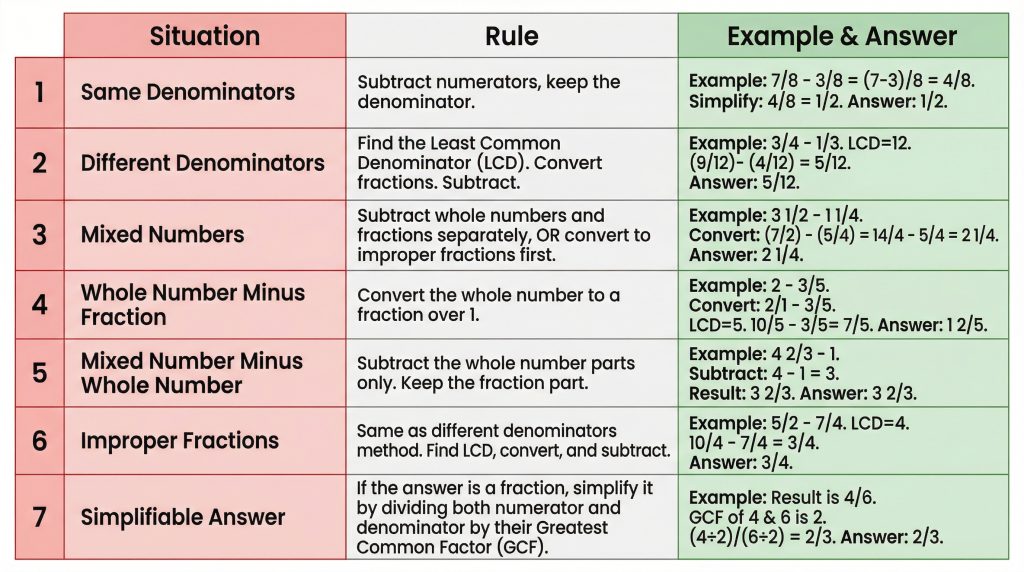
| Situation | Rule | Example | Answer |
|---|---|---|---|
| Same denominators | Subtract numerators — keep denominator | 7/8 − 3/8 | 1/2 |
| Different denominators | Find LCD → convert → subtract | 3/4 − 1/3 | 5/12 |
| Mixed numbers | Subtract separately or convert to improper | 4⅓ − 1¾ | 2 7/12 |
| Whole number − fraction | Convert whole to fraction over 1 | 5 − 2/3 | 4⅓ |
| Mixed − whole number | Subtract whole parts only | 3½ − 2 | 1½ |
| Improper fractions | Same LCD method as proper fractions | 7/4 − 5/6 | 11/12 |
| Answer needs simplifying | Divide by GCF | 6/12 | 1/2 |
Common Mistakes When Subtracting Fractions
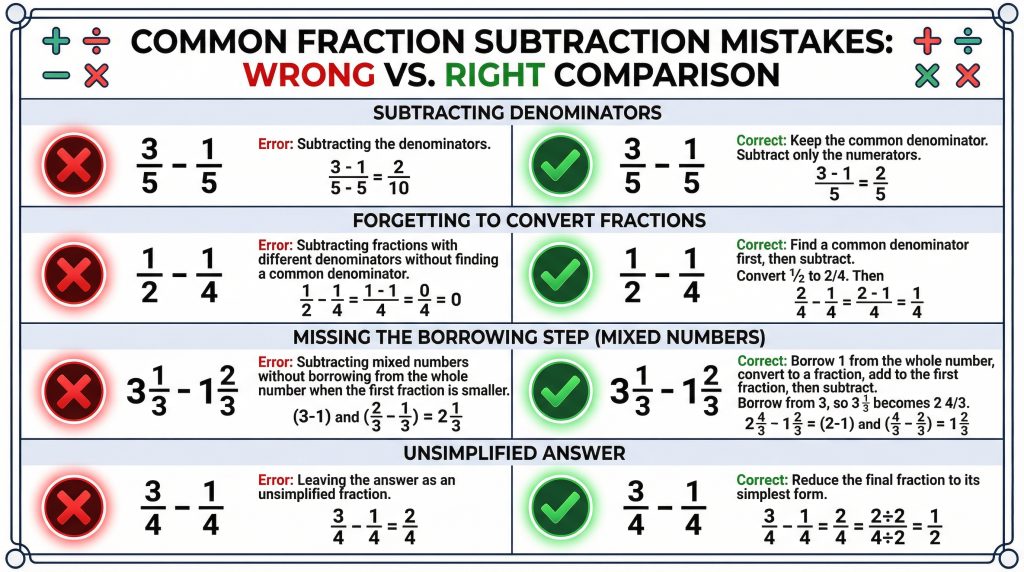
Being aware of these errors will save you time and frustration.
Mistake 1 — Subtracting the Denominators This is the most frequent error. The denominator represents the size of the pieces — it does not change when you subtract.
- ❌ Wrong: 5/8 − 3/8 = 2/0
- ✅ Right: 5/8 − 3/8 = 2/8 = 1/4
Mistake 2 — Forgetting to Convert Both Fractions When finding the LCD both fractions must be converted — not just one.
- ❌ Wrong: 1/2 − 1/3 → 3/6 − 1/3 (only one converted)
- ✅ Right: 1/2 − 1/3 → 3/6 − 2/6 = 1/6
Mistake 3 — Not Borrowing When Needed When subtracting mixed numbers and the second fraction is larger than the first you must borrow 1 from the whole number.
- ❌ Wrong: 3¼ − 1¾ = 2 and (¼ − ¾) = 2 and −½
- ✅ Right: Borrow → 2 and (1¼ − ¾) = 2 and ½
Mistake 4 — Not Simplifying the Final Answer Always check if the result can be reduced. An answer of 4/8 is technically correct but incomplete — the simplified form 1/2 is expected.
Subtracting Fractions — Worked Examples Summary
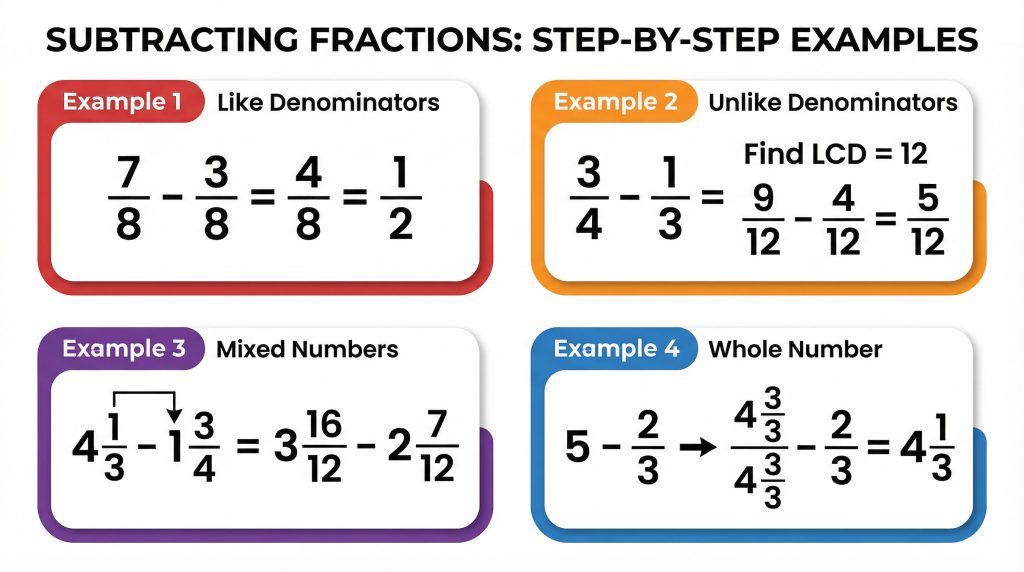
| Type | Problem | Answer | Key Step |
|---|---|---|---|
| Like denominators | 7/8 − 3/8 | 1/2 | Subtract numerators directly |
| Unlike denominators | 3/4 − 1/3 | 5/12 | Find LCD = 12 |
| Mixed numbers | 4⅓ − 1¾ | 2 7/12 | Borrow or convert to improper |
| Whole number | 5 − 2/3 | 4⅓ | Write 5 as 15/3 |
Frequently Asked Questions
What is the first step in subtracting fractions?
The first step is to check whether the denominators are the same. If they are the same subtract the numerators directly and keep the denominator. If they are different find the Least Common Denominator, convert both fractions to equivalent fractions with that denominator, then subtract the numerators.
How do I subtract fractions with different denominators?
To subtract fractions with different denominators: find the LCD of both denominators, multiply each fraction’s numerator and denominator by the number that converts its denominator to the LCD, subtract the new numerators and keep the LCD as the denominator, then simplify the result. Our subtracting fractions calculator shows every step of this process automatically.
How do I subtract mixed numbers?
There are two methods for subtracting mixed numbers. Method 1: subtract the whole number parts and fraction parts separately — borrowing from the whole number if the second fraction is larger. Method 2: convert both mixed numbers to improper fractions, find the LCD, subtract and convert back to a mixed number. Method 2 is recommended for beginners as it avoids borrowing.
What is 3/4 minus 1/2?
3/4 − 1/2 = 1/4. The LCD of 4 and 2 is 4. Convert 1/2 to 2/4. Subtract: 3/4 − 2/4 = 1/4.
What is 1/2 minus 1/3?
1/2 − 1/3 = 1/6. The LCD of 2 and 3 is 6. Convert 1/2 to 3/6 and 1/3 to 2/6. Subtract: 3/6 − 2/6 = 1/6.
Can I use a calculator for subtracting fractions?
Yes — the free subtracting fractions calculator at the top of this page solves any subtraction problem instantly and shows the complete step-by-step working. It handles like denominators, unlike denominators and mixed numbers. Use it to check your answers or to understand the method when you are stuck.
Where can I find a subtracting fractions worksheet?
Free printable subtracting fractions worksheets are available on our worksheets page covering all difficulty levels from like denominators through mixed number subtraction. Coming soon.
Is subtracting fractions harder than adding fractions?
Subtracting fractions follows exactly the same steps as adding fractions — find a common denominator, convert both fractions, then perform the operation on the numerators. The only additional challenge is borrowing when subtracting mixed numbers where the second fraction is larger than the first. If you can add fractions you can subtract them.
Related Fraction Tools and Guides
- How to Add Fractions — the complete guide to fraction addition
- Adding Fractions Calculator — instant answers with step-by-step working
- Multiplying Fractions — coming soon
- Dividing Fractions — coming soon
- Simplifying Fractions — coming soon
- Free Fraction Worksheets — coming soon
Conclusion
You now have everything you need to subtract any fraction confidently. The key is always the same — make the denominators equal first, then subtract the numerators. For subtracting fractions with like denominators this is immediate. For subtracting fractions with unlike denominators it requires finding the LCD first. For subtracting mixed numbers choose either the separate method or the improper fraction conversion method.
Use the subtracting fractions calculator above whenever you need instant verification — it shows every step of the working so you learn the method alongside getting your answer.
For addition practice visit our complete guide to adding fractions and the adding fractions calculator.